Date time post
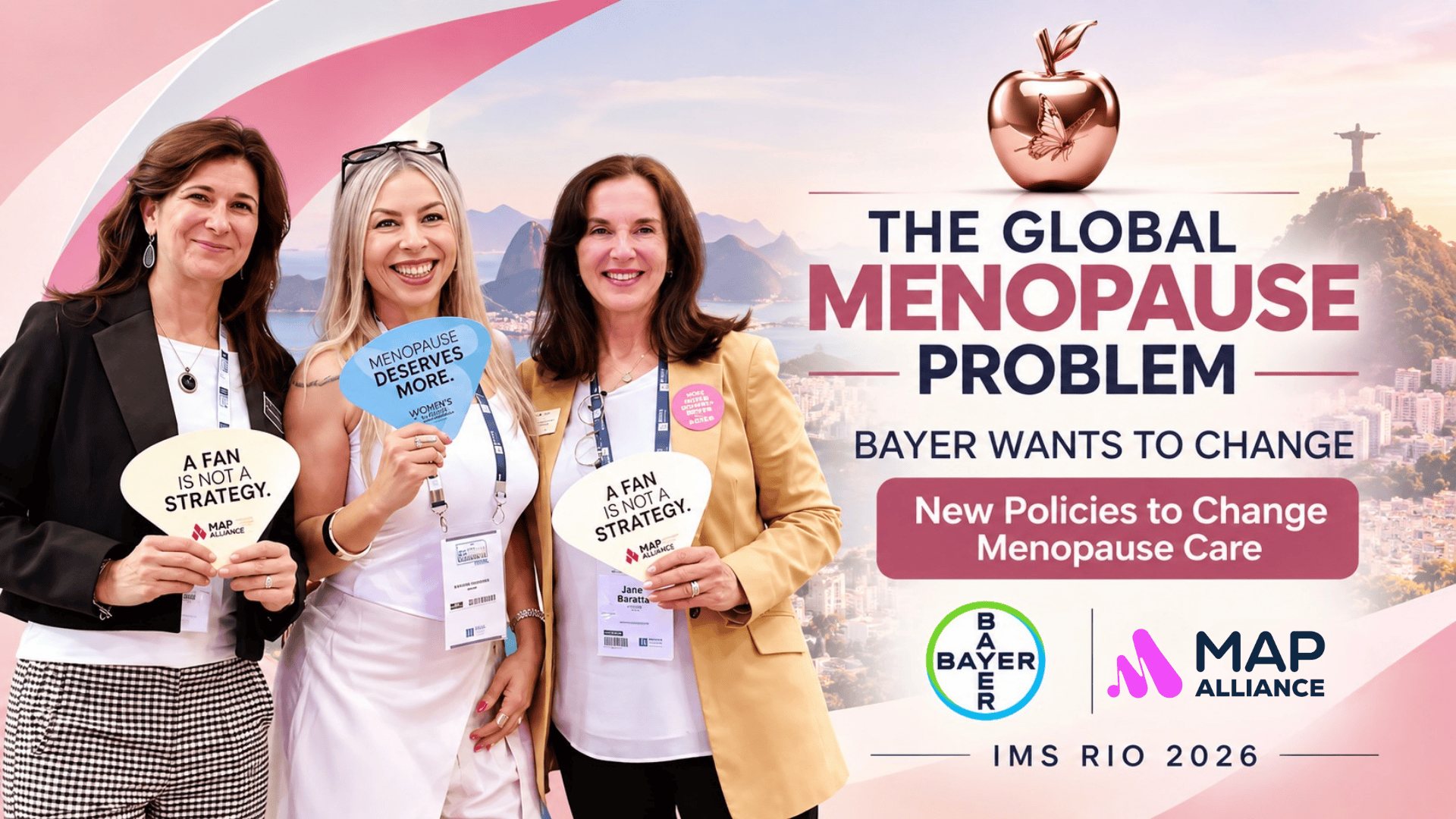
New policies to transform menopause care: a conversation with Dr. Jane M. Barratt and Michelle Sylvanowicz during the IMS World Congress 2026 in Rio de Janeiro
For decades, menopause has largely been treated as an individual health issue, discussed privately between women and their doctors.
But menopause is much bigger than that.
It affects healthcare systems, workplaces, public policy, economic participation, access to information and, ultimately, the quality of life of millions of women around the world.
That is the broader conversation now emerging at the global level.
During the IMS World Congress 2026 in Rio de Janeiro, the Menopause Advocacy and Policy (MAP) Alliance was officially launched with the goal of turning growing awareness of menopause into practical action across healthcare, policy and workplaces.
The MAP Alliance brings together stakeholders from different sectors to examine evidence, identify gaps and support changes in systems that affect women experiencing menopause. The initiative is funded and facilitated by Bayer.
I spoke with Dr. Jane M. Barratt, Global Advisor on Ageing, Health and Social Policy, founding member and Chair of the MAP Alliance, and Michelle Sylvanowicz, MAP Alliance ExCo member and VP Global Advocacy and Access Collaborations Lead at Bayer, during the Congress to understand what needs to change and why menopause has become a global policy issue.
A global problem with very different realities
One of the first findings presented by the MAP Alliance is striking: no country assessed has yet established a mature, fully funded and coordinated approach to menopause care.
The Alliance’s first issue brief examined menopause policies across 12 countries, looking at different areas of progress and identifying important gaps.
The challenge is not simply whether a country has menopause information or whether healthcare professionals have heard about menopause.
It is whether the different pieces actually connect.
Awareness. Healthcare access. Professional education. Workplace support. Research and evidence.
Without coordination between these areas, progress remains fragmented.
And without reliable data, it becomes much harder to demonstrate the scale of the problem, build evidence and secure the investment necessary to change systems.
When menopause becomes a workplace issue
Menopause does not stop at the doctor’s office.
For millions of women, it is also a workplace issue.
During our conversation, the discussion turned to a reality that many women know but may be reluctant to say out loud: talking about menopause at work can feel risky.
A woman experiencing symptoms may hesitate to speak with her manager because she fears being judged, losing opportunities, damaging her professional identity or even putting her income at risk.
The MAP Alliance is examining practices that can help create workplaces where women can remain healthy, productive and engaged throughout midlife.
This is particularly important because menopause often occurs during a period when women are simultaneously navigating professional responsibilities, relationships, children and other demands of adult life.
The question, therefore, is not simply how to help women manage symptoms.
It is how to build environments in which women do not have to choose between their health and their participation in society.
There is no single global menopause experience
One of the most interesting aspects of the MAP Alliance’s work is recognizing that menopause cannot be addressed with a single universal formula.
The reality in Canada is different from that in the United States.
Latin America faces different challenges.
And even countries with relatively strong healthcare systems can have significant gaps in education, access and professional training.
In some places, awareness is already high but misinformation is a serious problem.
In others, the conversation about menopause has barely begun.
Michelle Sylvanowicz, MAP Alliance ExCo member and VP Global Advocacy and Access Collaborations Lead at Bayer, highlighted the importance of ensuring that increased awareness is accompanied by credible, responsible information.
Social media has helped bring menopause into public conversation, particularly in countries where awareness is already growing rapidly. But greater visibility can also create space for misinformation.
Awareness, on its own, is not enough.
It needs to lead to informed conversations, better healthcare and meaningful policy.
Latin America is still at the beginning of the conversation
The Latin American context deserves particular attention.
During the interview, Michelle noted that awareness in the region is still developing and that this creates an important starting point for policy conversations.
Before governments can create effective policies, people need to understand the issue.
Before healthcare systems can respond, there needs to be data.
And before meaningful change can happen, menopause needs to be recognized as a legitimate public health and social issue.
The situation is not simply about access to treatment. It also involves whether women know where to seek help, whether healthcare professionals are adequately prepared and whether systems are designed to respond to women’s needs.
The message from the MAP Alliance is clear: no country is doing everything right yet.
There is still a long way to go in advocacy, policy and clinical care.
From awareness to action
The launch of the MAP Alliance comes at a moment when menopause is receiving unprecedented attention.
But attention is not the same thing as change.
The Alliance’s work is built around the idea that evidence and collaboration can help transform awareness into action.
Its initial work includes research examining the impact of menopause on individuals and society, as well as a 12-country assessment of menopause care policy.
The broader objective is to help identify what is working, where the gaps are and what can be done differently.
The MAP Alliance is calling for greater awareness and access to reliable information, expanded access to care, improved healthcare professional education and supportive workplaces.
These are not isolated issues.
They are pieces of the same system.
What could menopause look like ten years from now?
Perhaps the most powerful part of our conversation was looking beyond today’s gaps.
The vision expressed by the MAP Alliance is that, within the next decade, women will be able to navigate menopause with confidence.
That means being able to understand what is happening to their bodies.
Knowing where to find reliable information.
Having access to appropriate healthcare.
Being able to talk about menopause without fear.
And being supported by workplaces and public policies that recognize menopause as part of women’s lives rather than something women are expected to manage silently.
It is an ambitious goal.
But it also represents a fundamental shift in the way menopause is understood.
From a private issue to a public health issue.
From awareness to policy.
From individual responsibility to systemic responsibility.
The conversation cannot stay inside the conference room
There was another point from the interview that stayed with me.
International conferences bring together people who are already deeply engaged in the subject.
But millions of women are still outside that conversation.
They may not know that menopause is a normal biological transition.
They may believe that their symptoms are something they simply have to endure.
They may not know where to seek reliable information.
Or they may be afraid to speak.
That is why communication matters.
Taking this conversation beyond medical conferences, policy meetings and specialist circles is part of the work itself.
And that is also why independent media, creators, journalists and communicators have a role to play in bringing evidence-based information to women in different communities and different parts of the world.
During our interview, Jane and Michelle emphasized the importance of reaching women beyond the people already participating in the menopause conversation.
That is where awareness can begin to become action.
A global transition requires a global response
Menopause is experienced by women around the world, but the systems supporting them remain profoundly unequal.
The MAP Alliance is attempting to bring those different realities into the same conversation: healthcare, public policy, workplaces, research, education and women’s lived experiences.
Its work is still at the beginning.
But the question it raises is already important:
If menopause affects health, work, economic security and quality of life on a global scale, why should menopause care remain fragmented?
The challenge now is to move from conversation to implementation.
From awareness to evidence.
From evidence to policy.
And from policy to real change in women’s lives.
Menopause is a global experience. Caring for it must be global, too.
About the MAP Alliance
The Menopause Advocacy & Policy (MAP) Alliance is a global alliance of cross-sector stakeholders working to synthesize evidence and insights into local action that can lead to measurable change in menopause.
Its mission is to advance effective policies and systems that promote timely and quality menopause care and to transform workplaces to better support women experiencing menopause.
The MAP Alliance is funded and facilitated by Bayer.
About the interview
This article is based on an interview recorded during the IMS World Congress 2026 in Rio de Janeiro for the podcast Menopausa: Muito Prazer! | Menopause: Pleased to Meet You.
Guests:
Dr. Jane M. Barratt
Global Advisor on Ageing, Health and Social Policy
Founding member and Chair of the MAP Alliance
Michelle Sylvanowicz
MAP Alliance ExCo member and VP Global Advocacy and Access Collaborations Lead at Bayer
Latest News
- 15 de September de 2026
- 9 de September de 2026

- 1 de September de 2026

- 24 de August de 2026