
Date time post
Sub HeadingWhat Happens Between Menopause Appointments? David Franklin on LUCI and Women’s Health Data
A woman’s health does not pause when she leaves the doctor’s office.
Her symptoms continue. Her sleep changes. Her menstrual cycle evolves. Her blood pressure fluctuates. She may start or change medication, experience new symptoms, notice patterns in her mood or energy, and use wearable devices that generate information about her body every day.
Yet much of that information can disappear before the next clinical appointment.
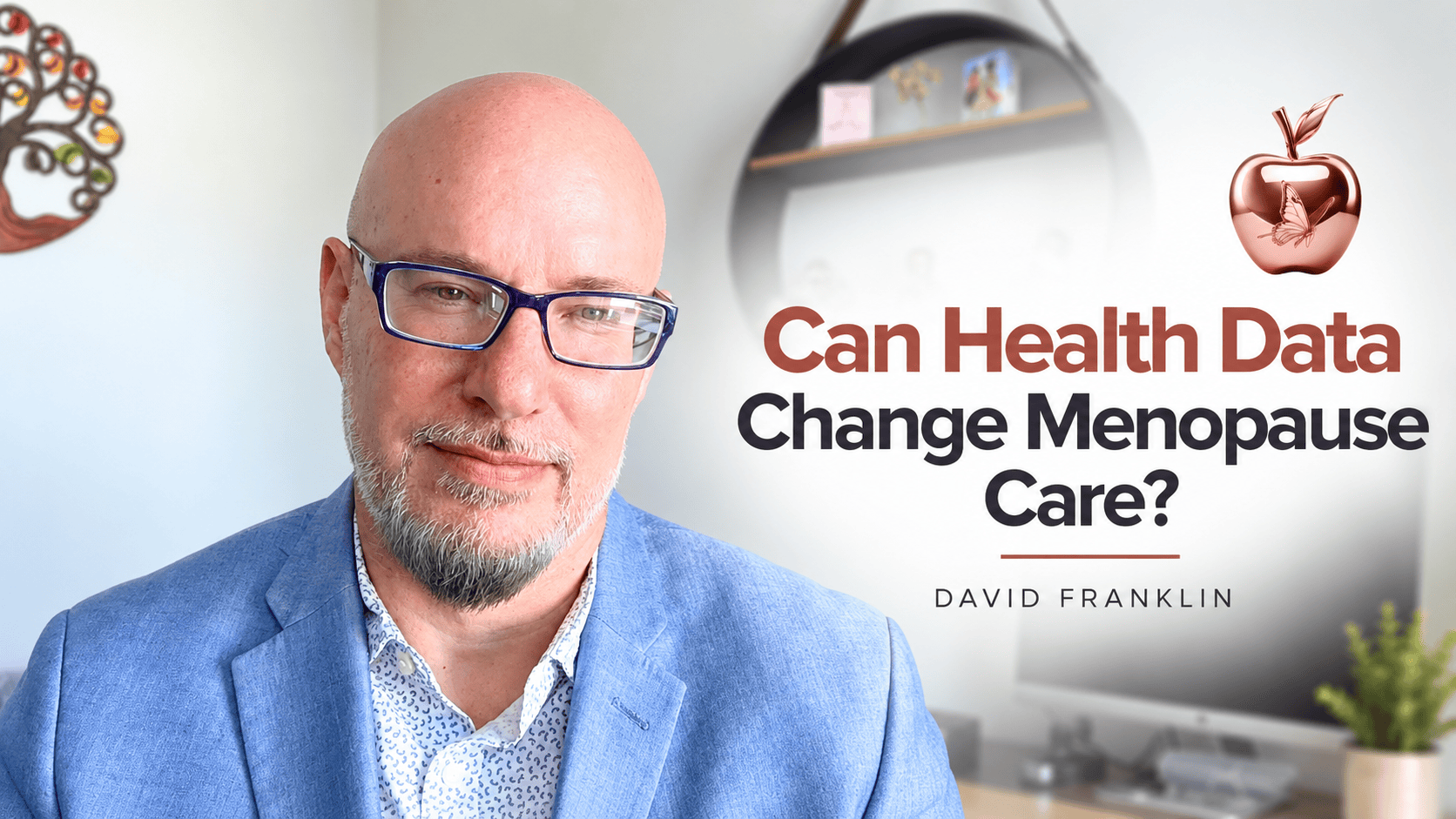
That gap between everyday life and episodic healthcare is at the center of Izadora Guimarães’s conversation with David Franklin, Founder and CEO of Naviday Health. A technologist working at the intersection of women’s health and data, Franklin believes menopause exposes a broader problem in healthcare: women generate an enormous amount of information about their health, but the systems designed to care for them do not always capture, organize or use that information longitudinally.
His response is LUCI, Lifestyle Understanding, Care Intelligence, a platform designed to connect real-world health data with the clinical journey.
Menopause Is More Than a Moment on the Calendar
One of the first ideas Franklin challenges is the way menopause is framed.
Menopause itself has a precise clinical definition, but the experience surrounding it is much larger. Franklin emphasizes the need to distinguish among perimenopause, menopause and post-menopause rather than treating the entire journey as one moment defined primarily by the end of fertility.
That distinction matters because the years leading up to menopause can involve a wide range of changes. In the interview, Franklin points out that symptoms may be interpreted or categorized as something else, particularly when there is no clear clinical pathway connecting them to the menopausal transition.
The result can be a frustrating cycle. A woman experiences something unusual, searches for an explanation, visits a clinician and receives a diagnosis or treatment based on the information available at that particular moment. Then she goes home and continues living with a much larger story that may never make it into the medical record.
For Franklin, this is partly an infrastructure problem.
Healthcare has pathways for many chronic conditions, but menopause has historically received less systematic attention. When symptoms are not connected across time, the clinical picture can become fragmented.
And fragmentation is precisely what longitudinal health data is designed to address.
The Problem Is Not a Lack of Data. It Is the Gap Between Data and Care
Franklin describes a striking paradox: women are constantly generating health information, but healthcare often sees only snapshots.
A clinical visit might happen three or four times a year. Between those appointments, however, a woman continues to experience symptoms and changes in her health. Wearables can generate information about activity, sleep and other measures. Women can track symptoms, medications, menstrual cycles and assessments. Blood pressure can be measured at home.
The question is not simply whether this information exists.
The question is what happens to it.
LUCI was developed around this idea of turning everyday information into something that can become useful within a healthcare journey. According to Franklin, the platform brings together symptom tracking, medication information, clinical assessments, menstrual tracking and connected health data.
The goal is not to create another place where women accumulate numbers.
It is to create a more coherent story.
That distinction is important. Data without context can become another burden for the patient. The value, in Franklin’s vision, comes from organizing information longitudinally so that patterns become easier to recognize and conversations with healthcare professionals can become more informed.
LUCI and the Consumer Health Record
One of the most interesting concepts discussed in the interview is the Consumer Health Record.
Rather than leaving a woman’s health information scattered across different applications, devices, appointments and pieces of paper, LUCI is designed to synthesize information into a portable record. Franklin describes a system in which a woman can share her health story with a clinician through a QR code.
The idea is particularly relevant for anyone who has ever had to repeat the same medical history from the beginning.
Imagine arriving at a new healthcare provider and being able to share a structured picture of your symptoms, medications, clinical assessments and menstrual history rather than trying to reconstruct months of experiences from memory.
The technology does not eliminate the clinician. It changes the information available to the clinician.
That is an important distinction in the conversation. Franklin repeatedly describes LUCI as a bridge between what happens in everyday life and what happens inside clinical care.
The woman remains at the center of that process.
From LUCI to MERCI: Looking at Cardiovascular Risk
The conversation takes another turn when Franklin introduces MERCI, the Menopause Early Risk of Cardiovascular Index.
The concept emerged from his interest in what happens to cardiovascular risk during midlife and how that information might be captured more continuously. Franklin argues that episodic clinical visits may not reveal the moment when a person’s risk trajectory begins to change.
MERCI is presented in the interview as an attempt to use multiple sources of information, including clinical assessments and real-world data, to identify patterns that could eventually contribute to cardiovascular prevention.
This is also where the conversation becomes a reminder of the difference between a promising technology and an established clinical tool.
Franklin describes what Naviday is developing and studying. He speaks about the potential of longitudinal data to identify patterns and improve understanding. That is different from saying that LUCI or MERCI has already established a new clinical standard.
The distinction matters, particularly in women’s health, where technology can generate excitement long before evidence has matured.
Technology Cannot Work If Women Are Left Out
Another important part of the conversation is diversity.
Franklin emphasizes that the data used to understand women’s health cannot come from a single population and then be assumed to represent everyone. Symptoms may be reported differently. Treatments may vary. Diagnostic practices can differ. Culture can influence how women describe their experiences and whether they seek care at all.
For a global women’s health platform, that creates a major challenge.
A technology developed in one country cannot simply be dropped into another and expected to work in exactly the same way. Franklin makes this point directly when discussing Brazil. Translation, he argues, is not enough.
For LUCI to genuinely serve Brazilian women, he says, the experience needs to be available in Brazilian Portuguese and adapted to the local cultural context.
That idea goes beyond language.
It is about meeting people where they are rather than expecting people to adapt themselves to the technology.
Who Owns the Data?
Perhaps one of the most consequential parts of the conversation is also one of the least glamorous: consent.
Health technology inevitably raises questions about who can access personal information, how data is used and whether women understand what they are agreeing to when they use an application.
Franklin describes consent as fundamental to the way Naviday approaches data. In the interview, he says that without consent, the information remains essentially contained. If a woman consents, she can choose whether it becomes available for research or whether it is shared with her clinician.
That philosophy changes the relationship between the woman and her data.
Instead of treating health information as something automatically available to a company or institution, the model presented by Franklin puts the woman in the position of deciding what happens next.
That matters especially in women’s health, a field in which gaps in historical research have left many questions unanswered.
If better research requires better data, the solution cannot simply be to collect more information.
It has to involve trust.
And trust requires transparency.
Menopause Is Not Only a Women’s Conversation
Franklin also brings a personal perspective to the discussion.
As a father, he talks about how normalized conversations around menstruation became in his own family and how different his experience was from the silence that surrounded his mother’s menopause. He recognizes, in retrospect, how little he understood about what she was experiencing.
That realization led him toward another project: MenInPause, a podcast designed to help men listen, understand and become better allies during menopause.
The premise is refreshingly simple.
Women lead. Men listen.
Menopause affects relationships, families and workplaces, yet men are often left outside the conversation. Sometimes they are excluded because nobody knows how to talk about it. Sometimes because menopause remains associated with aging, intimacy or subjects considered too private.
Changing that dynamic does not mean turning men into experts on menopause.
It means giving them enough understanding to listen without dismissing, support without assuming, and participate without taking over the conversation.
A Different Way of Looking at the Transition
Near the end of the interview, Franklin moves away from technology and offers a more personal message.
He tells women to create space for themselves.
His advice comes from his own experience of realizing that he had become something to everybody but nothing to himself. For women navigating the enormous demands of midlife, he argues that creating healthy boundaries and finding time for oneself is not selfish. It is necessary.
There is a striking connection between that message and the technology discussed throughout the interview.
Both begin with paying attention.
LUCI attempts to make the woman’s health journey more visible by capturing information that might otherwise disappear between appointments. Franklin’s personal message asks women to make themselves visible in their own lives by creating space to notice what they need.
The technology is about data.
The deeper conversation is about attention.
What If Healthcare Could See More of the Story?
The most interesting question raised by this conversation is not whether technology will replace doctors.
It is whether technology can help doctors see more of the woman sitting in front of them.
Menopause makes that question particularly relevant because the transition unfolds over time, symptoms can be varied, and the experience extends far beyond the moment at which menstruation stops.
David Franklin’s work with Naviday Health and LUCI is built around the idea that healthcare should not have to reconstruct a woman’s story from a few isolated appointments.
Her health story is happening every day.
The challenge is learning how to listen to it.
And perhaps that is one of the most important shifts taking place in women’s health: moving from asking women to remember everything that happened between appointments to building systems that can help make that journey visible.
More data is not automatically better healthcare.
But better-connected information, meaningful consent, cultural understanding and a woman at the center of the conversation could help create a very different experience of care.
That is the possibility explored in this conversation between Brazil and the United States.
And it is a conversation that is only beginning.
Watch the Full Interview
Watch the full conversation between David Franklin and Izadora Guimarães on Menopause: Pleased to Meet You.
WATCH THE FULL EPISODE ON YOUTUBE
Menopause: Pleased To Meet You is part of the Multiverse of Women 40+, bringing together conversations about health, menopause, longevity, behavior, culture, lifestyle and the many dimensions of life after 40.
More Play & Less Pause!
Latest News
- 9 de September de 2026

- 1 de September de 2026

- 24 de August de 2026

- 22 de August de 2026