Date time post
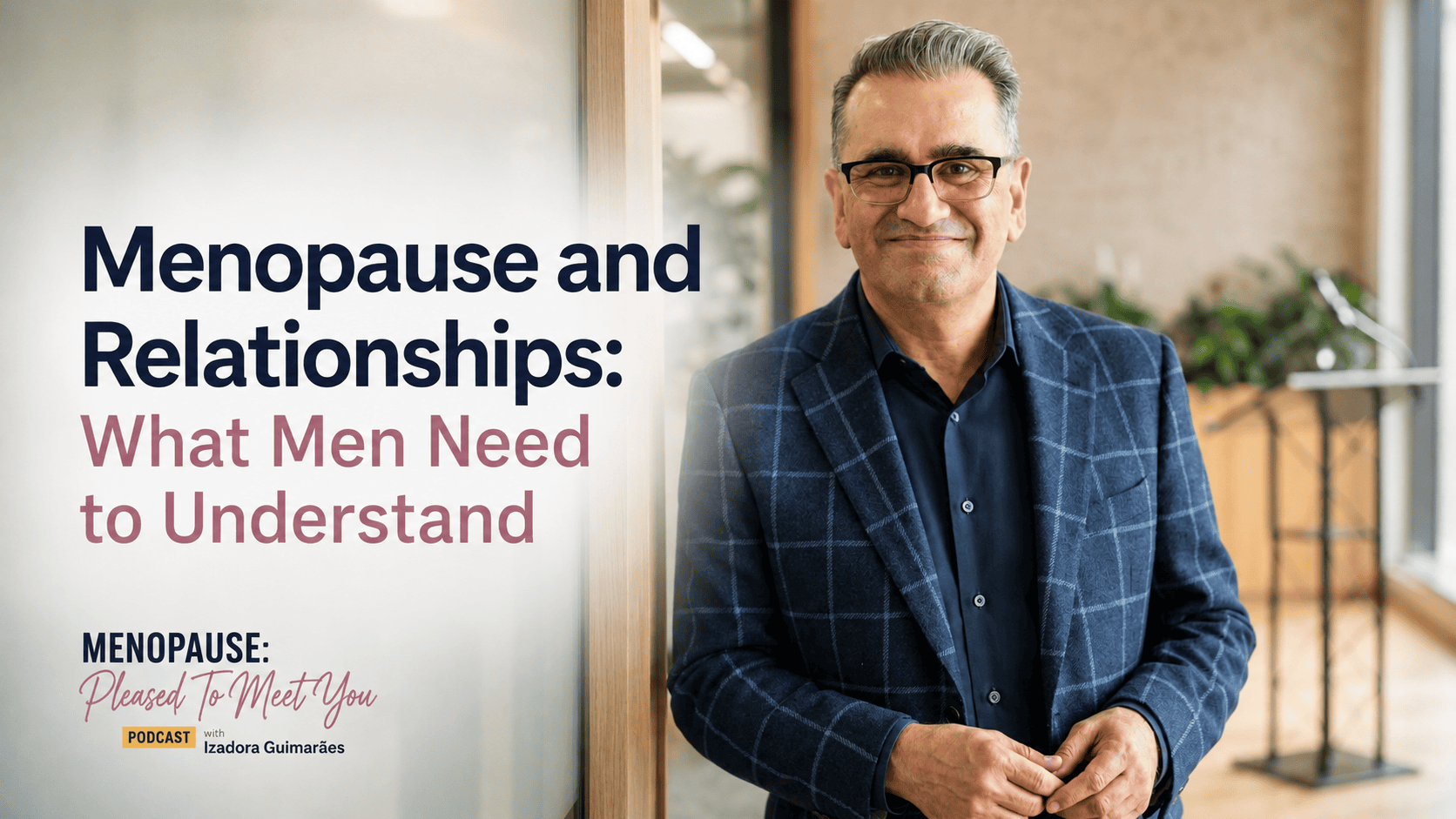
Menopause and Relationships: What Men Need to Understand
Menopause and relationships are closely connected, yet the impact of menopause on intimacy, communication and partnership is often overlooked.
In this episode of Menopause: Pleased To Meet You, Izadora Guimarães speaks with
Simon Salt, who began talking about menopause after experiencing his wife’s perimenopause journey and seeing how difficult it was for both partners to understand what was happening.
Their conversation explores intimacy, communication, education, emotional connection and one of the most important questions partners can ask during menopause:
How do we navigate this together?
When Menopause Changes a Relationship
Simon says his story began about eight years ago, when his wife entered perimenopause.
Over a period of four years, she saw four diff erent doctors and was given several explanations for what she was experiencing, including aging, yeast infections and urinary tract infections. Perimenopause was not initially identified.
During that time, Simon could see that something was changing in their relationship, but he did not understand why.
Because he did not have the information to understand what his wife was experiencing, he began to question himself and wonder whether something he was doing or saying was contributing to the changes.
This experience eventually led him to an important realization: sometimes a relationship does not need a solution. It needs understanding.
“Your Partner Isn’t Broken”
One of Simon’s central messages is that men often approach problems by looking for solutions.
But menopause is not something that needs to be “fixed.”
As Simon puts it, “your partner isn’t broken.”
Menopause is a life stage that can involve signifi cant physical, mental and emotional changes. For couples, that can mean adapting to a new reality rather than trying to return to the relationship exactly as it was before.
The goal is not to find a quick fix.
It is to understand what is happening and learn how to move through it together.
Menopause Can Change Intimacy
Intimacy is one of the most important subjects Simon discusses.
Menopause and perimenopause can aff ect both physical and emotional intimacy. When someone is experiencing major changes in their body, mood, energy or symptoms, they may not always have the capacity to give or receive physical or emotional connection in the same way.
Partners can easily interpret these changes personally.
A woman may need more space, while her partner may interpret that distance as rejection. A change in desire may be interpreted as a loss of love. A difficult moment may be interpreted as a sign that something is fundamentally wrong with the relationship.
Simon argues that couples may need to renegotiate their relationship as they move through this life stage.
That does not necessarily mean the relationship is ending.
It means the relationship is evolving.
Menopause Is a Life Stage, Not a Short-Term Problem
Simon also points out that the menopause transition is not something couples can expect to navigate for a few weeks and then simply move past.
Perimenopause can unfold over years, and experiences vary considerably from one woman to another.
That means couples may need to keep communicating and adapting as circumstances change.
Instead of thinking:
“How do we fi x this?”
the conversation can become:
“How do we navigate this together?”
That shift can help couples see themselves as being on the same team.
Men Need to Learn About Menopause
One of the strongest messages in Simon’s experience is that men need to take responsibility for learning.
Women can guide their partners toward useful information, but they should not have to repeatedly educate the person beside them while simultaneously dealing with their own symptoms and changes.
Simon discovered that researching menopause for himself made it much easier to understand what his wife was experiencing.
Reading about a symptom is one thing.
Understanding how that symptom aff ects the person you love is another.
For example, knowing what a hot fl ash is biologically does not necessarily tell a partner what that experience feels like for the woman having it.
Education creates the foundation.
Listening creates understanding.
Listen, Don’t Just Wait to Talk
Simon emphasizes active listening as one of the most important skills couples can develop.
Listening is not simply waiting for your turn to respond.
It means being present and trying to understand what your partner is actually telling you.
This matters because menopause does not look exactly the same for every woman.
Symptoms can vary. Timing can vary. Intensity can vary.
Emotional impact can vary.
A partner’s experience cannot be completely understood through a generic checklist.
The person experiencing menopause remains an essential source of information about what is happening to her.
Give Your Partner Space When She Needs It
Simon describes how confusing this can be for men.
When someone they love is suff ering, many men instinctively want to do something to help. But sometimes the most helpful response is not physical closeness or an immediate solution.
Sometimes the person needs space.
Without understanding what is happening, a partner may interpret that need for space as rejection and begin wondering whether something is wrong with the relationship.
Education can change that interpretation.
Instead of thinking:
“She’s pulling away from me.”
a partner can begin asking:
“What does she need right now?”
That diff erence can completely change the conversation.
Menopause Can Be a Time of “Unmasking”
Simon also describes midlife as a period when some women may no longer have the capacity to continue doing everything they have always done for everyone else.
He uses the idea of “unmasking” to describe part of this transition.
As hormones change, women may reassess what they are willing or able to continue carrying, including expectations they have lived with for years.
For partners, this can be challenging.
But understanding the transition can make it easier to see these changes as part of a broader life stage rather than automatically interpreting them as a threat to the relationship.
Why Simon Started Talking About Menopause
Simon previously worked in digital marketing and had already written three books about marketing.
After his own experience, he decided he wanted to help other men avoid the confusion he had experienced.
He began writing about menopause on Substack, creating a weekly newsletter focused primarily on helping men better understand what their partners may be experiencing.
Interestingly, Simon says that around 80% of his subscribers are women, many of whom then share his content with the men in their lives.
His goal is not to put men at the center of the menopause conversation.
It is to bring them into the conversation.
Menopause Should Not Be a Threat to the Relationship
Simon describes how some men can respond to major changes in a relationship through a fi ght-or-fl ight response.
They may shut down, withdraw or put up a wall because they do not understand what is happening.
When menopause is interpreted as a threat to the relationship, the result can be more distance at exactly the moment when better communication is needed.
Education can help break that cycle.
Understanding that menopause is a life transition, rather than evidence that the relationship is necessarily ending, can give couples more room to communicate.
As Simon explains, perimenopause does not necessarily cause relationship breakdowns, but it can reveal problems that were already there.
The Quiet Transition
Simon calls his work The Quiet Transition.
The phrase refl ects the fact that menopause can unfold gradually, sometimes quietly, while still producing profound changes in a woman’s life and within a relationship.
It also refl ects the fact that menopause remains a subject that many people do not talk about enough.
Simon believes that normalizing the conversation is part of the solution.
Men need opportunities to encounter reliable information, hear other men’s experiences and become comfortable participating in conversations about menopause.
The conversation remains centered on women’s health, as it should.
But partners do not have to remain outside looking in.
They can learn, listen and participate.
Menopause Education Is Also Relationship Education
Simon and Izadora also discuss differences between the UK and the US.
Simon observes that menopause awareness and workplace conversations have progressed further in the UK, while the conversation in the US is growing but remains uneven.
The broader point is that menopause education extends beyond healthcare.
It can aff ect workplaces, families, relationships and society.
When people understand what menopause is, women may feel less isolated and partners may have a better framework for understanding what is happening.
The Three Things Men Can Do: Sit, Listen, Believe
At the end of the conversation, Simon shares a simple three-step approach for men.
1. Sit
Set aside time to be with your partner without distractions.
No children. No chores. No multitasking.
Just the two of you.
Even five or ten minutes can create space for a real conversation.
2. Listen
Listen actively.
Do not simply wait for your turn to speak.
Pay attention to what your partner is actually telling you and remember that both partners need to develop this skill.
3. Believe
Research is important.
Read books, articles and reliable resources. Listen to experts. Learn about menopause.
But ultimately, the woman experiencing menopause is the most important source of information about her own experience.
A symptom does not have to happen exactly the way a textbook, social media post or infl uencer described it.
If her experience is diff erent, believe her experience.
That is where understanding begins.
Menopause Does Not Have to Mean the End of a Relationship
Menopause can bring signifi cant changes to a relationship.
It can aff ect intimacy, communication, emotional connection and the way partners understand each other.
But change does not automatically mean failure.
For Simon, the experience became an opportunity to learn, listen and help other men understand what he once struggled to understand himself.
Men do not need to have all the answers.
They do need to be willing to learn.
And sometimes the most important thing a partner can do is not fi x the problem.
It is understand the person.
Watch the Full Conversation
Watch Izadora Guimarães’ conversation with Simon Salt and discover his perspective on menopause, relationships, intimacy, communication and the role men can play in supporting their partners.
WATCH THE FULL EPISODE ON YOUTUBE
Menopause: Pleased To Meet You brings together conversations about menopause, women’s health, longevity, relationships, culture and the many dimensions of life after 40.
Explore more conversations and stories from the Multiverse of Women 40+ at Menopause: Pleased To Meet You.
More Play & Less Pause.
Latest News

- 13 de October de 2026
- 15 de September de 2026
- 9 de September de 2026

- 1 de September de 2026