Date time post
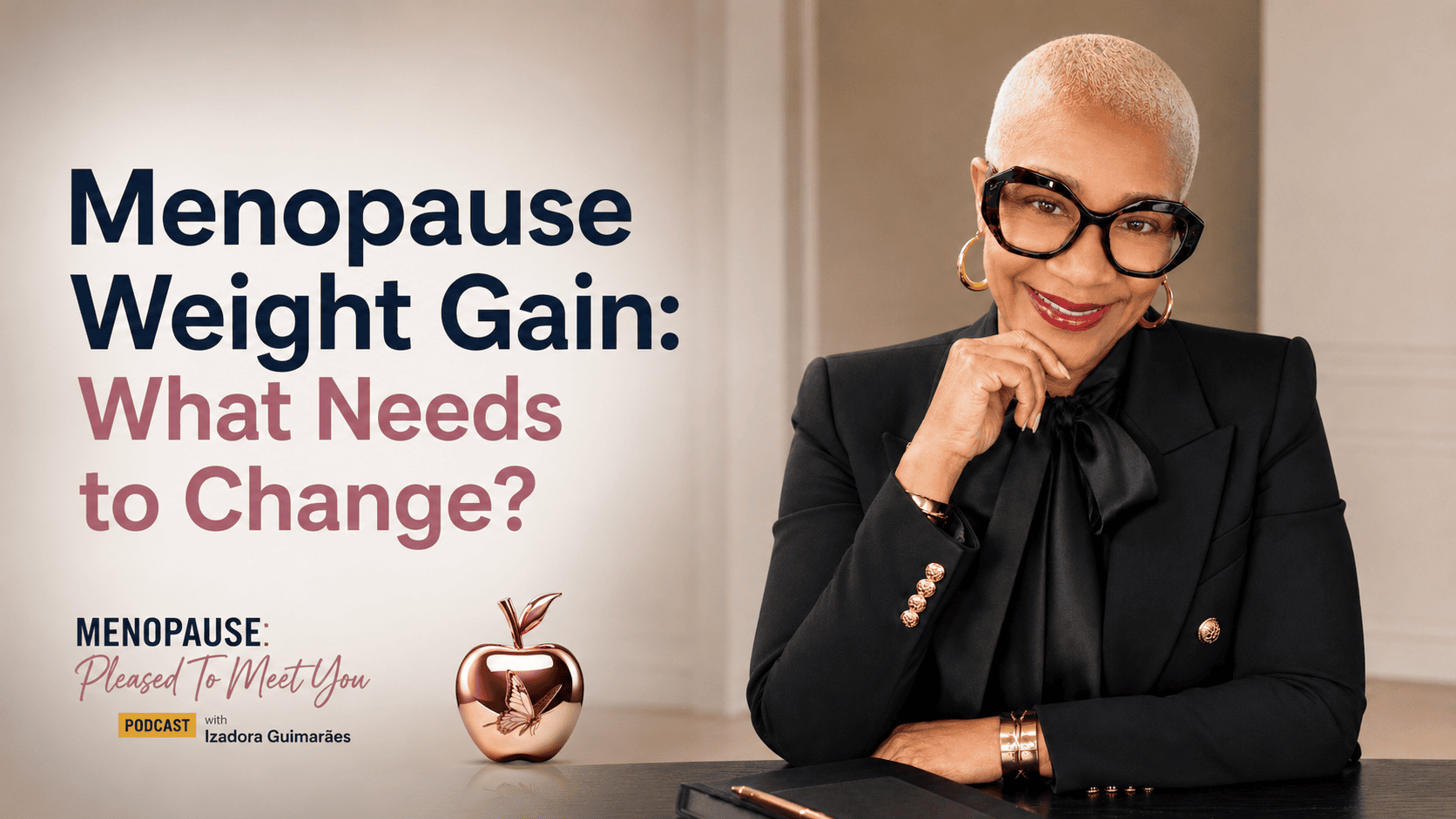
Menopause Weight Gain: What Needs to Change?
You’re exercising. You’re paying attention to what you eat. Your habits haven’t dramatically changed.
And yet, your body has.
For many women, menopause weight gain can feel particularly frustrating because the strategies that worked for years may no longer seem to produce the same results.
That feeling of confusion is at the center of Anngie Jenkins’ story.
In this episode of Menopause: Pleased To Meet You, Izadora Guimarães speaks with Anngie, a certified nutritionist and founder of Gen X Post Menopause Solutions, about weight gain, nutrition, metabolic health and the years she spent trying to understand what was happening to her body.
For Angie, finding answers eventually changed much more than her own health. It led her to the work she does today.
Seven Years of Confusion During Menopause
Looking back, Angie believes the changes began around a decade ago.
She was exercising with a trainer, paying attention to nutrition and following a vegan diet. Nevertheless, her body began responding differently.
For approximately seven years, she describes living in what she calls a “state of confusion.”
She knew something was changing but struggled to find information that connected the pieces.
What made her experience even harder to recognize was that she didn’t have some of the menopause symptoms she expected.
There were no hot flashes.
She wasn’t struggling with sleep.
Instead, two symptoms dominated her experience: debilitating fatigue and rapid weight gain.
Even with adequate rest, Angie says she felt exhausted. At the same time, her weight was increasing despite continuing to exercise and eat in the way she had before.
Eventually, she decided something needed to change.
When Menopause Weight Gain Happens Despite “Doing Everything Right”
One of the most relatable parts of Anngie’s story is the question she kept asking herself:
Why is this happening when I’m doing everything right?
That question ultimately led her to work with a nutritionist.
Rather than immediately abandoning the way she ate, Angie began experimenting with changes while observing how her body responded.
Gradually, she started seeing results.
Importantly, this is Anngie’s individual experience, not a universal diet prescription for menopause. Her story illustrates something broader: changes in midlife may require women to reassess strategies that once worked for them.
Changing Her Vegan Diet Without Abandoning It
Angie had been vegan before her menopause journey began and wanted to remain vegan.
That created an additional challenge.
Several common protein sources weren’t options for her because of food preferences and allergies. She doesn’t eat foods such as tofu, tempeh or seitan, and she’s allergic to nuts.
Instead of abandoning veganism, she changed the structure of her diet.
Working with her nutritionist helped Anngie identify approaches she hadn’t previously tried. Over time, she adapted those ideas to her own preferences and needs.
The process involved trial and error rather than one dramatic dietary switch.
Anngie Lost 55 Pounds
During the interview, Anngie shares that she ultimately lost 55 pounds.
Her body changed considerably during the process. She describes going from a size 16 to a size 4.
However, the number on the scale isn’t the most important part of her story.
Anngie says she did not simply return to the way she had eaten before menopause. Instead, she transformed the changes she had made into long-term habits.
For her, the lesson was that this couldn’t be a temporary diet followed by a return to old routines.
It became a lifestyle.
Menopause Belly Fat and Body Changes
Weight wasn’t the only physical change Anngie noticed.
She describes significant bloating and abdominal weight gain during this period. In the interview, she remembers feeling that her stomach looked several months pregnant.
Changes in her breasts also made her suspect that hormones were part of what was happening to her body.
These experiences eventually pushed her to seek more information rather than simply accepting the changes without understanding them.
That distinction matters.
Body changes during midlife can have many contributing factors. Therefore, Anngie’s personal experience should not be interpreted as a diagnosis for every woman experiencing weight gain.
Instead, it illustrates why unexplained or significant changes deserve attention and, when appropriate, professional evaluation.
From Menopause Confusion to Metabolic Health Education
Anngie’s seven years of uncertainty eventually shaped her professional direction.
She was already working in healthcare. Later, she earned certifications in nutrition and weight loss and combined that education with her professional background and lived experience.
Today, her work focuses particularly on metabolic health during and after menopause.
What motivated her was simple: if she had struggled so much to find coherent information, other women were probably struggling too.
And their symptoms might look completely different from hers.
While Anngie’s main symptoms were fatigue and weight gain, other women she encountered described hot flashes, night sweats, brain fog and disrupted sleep.
That diversity of experiences reinforced one of the central themes of the conversation:
There is no single menopause experience.
Protein During Menopause
When Izadora asks Angie for one nutritional priority she would highlight for women during menopause, her answer is immediate:
Protein.
Anngie explains that protein became a much bigger priority in her own diet as she learned more about nutrition, muscle and metabolic health during menopause.
Because she remains vegan, she had to find sources that worked within her dietary restrictions.
One of the solutions she chose was plant-based protein powder. She also increased the amount of vegetables and plant foods in her meals.
Again, Anngie’s routine reflects her individual dietary choices rather than a prescription for every menopausal woman.
The broader lesson is to consider whether nutrition is adequately supporting changing needs during midlife.
Plant-Based Nutrition After Menopause
Anngie’s experience is particularly interesting because she didn’t abandon plant-based eating to achieve her goals.
Instead, she adapted it.
Previously, beans had been one of her primary protein sources. Over time, she changed the balance of her meals and incorporated plant-based protein powder along with vegetables.
Today, she describes vegetable stir-fries and plant-based protein as staples of her routine.
She also allows herself flexibility on holidays before returning to her usual habits afterward.
That approach reflects another theme running through the conversation: consistency matters more than temporary perfection.
Menopause Education Is Still Missing
The conversation eventually moves beyond nutrition and into a much larger problem: education.
Anngie remembers searching for answers and finding information only in disconnected fragments.
Even today, she believes the United States still has significant progress to make in menopause awareness, healthcare support and workplace understanding.
For generations, menopause wasn’t openly discussed in many families.
Mothers, grandmothers and aunts often didn’t explain what the transition might look like.
As a result, many women arrive at perimenopause without knowing what to expect.
Both Izadora and Anngie see the current generation as part of changing that pattern.
Every Woman’s Menopause Journey Is Different
The conversation also touches on hormone therapy and non-hormonal approaches.
Anngie explains that her own strategy is non-HRT, but she does not present that choice as the answer for every woman.
Instead, she emphasizes individual choice.
Women may experience menopause differently and make different decisions about how to manage their symptoms.
That principle is essential.
A personal success story can provide perspective and questions to consider, but it should not become a universal treatment protocol.
Preparing the Next Generation
One of the most hopeful parts of the conversation is the idea that younger generations may enter menopause better prepared.
Women are talking about menopause more openly.
Information is becoming easier to find.
Healthcare conversations are changing.
Still, progress depends on continuing to educate women before symptoms arrive, not only after they have spent years trying to understand what is happening.
Anngie believes women who have already lived through that confusion have an opportunity to make the transition easier for those who come next.
Anngie’s Advice: Education First
At the end of the interview, Izadora asks Anngie what she would say to a woman currently facing the same struggles she once experienced.
Her answer is remarkably simple:
Education first.
When women understand menopause and their own bodies better, Anngie believes they can ask better questions and make more informed decisions about their health.
Information doesn’t dictate one particular treatment, diet or lifestyle.
Instead, it gives women a stronger starting point for discussing their individual needs with appropriate professionals and deciding what works for them.
And perhaps that is the biggest lesson from Anngie’s seven-year search for answers.
Menopause doesn’t come with one universal roadmap.
But women shouldn’t have to navigate it without a map at all.
Watch the Full Conversation
Watch Izadora Guimarães’ full conversation with Anngie Jenkins about menopause weight gain, nutrition, metabolic health, plant-based eating and why education matters.
WATCH THE FULL EPISODE ON YOUTUBE
Menopause: Pleased To Meet You brings together international conversations about menopause, women’s health, longevity, relationships, culture and the many dimensions of life after 40.
More Play & Less Pause.
Latest News
- 13 de October de 2026
- 15 de September de 2026
- 9 de September de 2026

- 1 de September de 2026