Date time post
My Menopause Story: When a Hormone Prescription Changed Everything
There are moments in life when you realize that you don’t recognize yourself anymore.
For me, that moment happened during menopause.
In 2022, at 47, I was going through perimenopause without even knowing it. I had a Mirena IUD and no longer had periods, so I didn’t have the usual menstrual clue that something was changing.
Then I started feeling different.
I became sad for no obvious reason. I cried frequently. I couldn’t sleep.
At first, I thought I might be developing depression.
I had no idea that I was entering menopause.
I didn’t know I was in perimenopause
At the time, I believed menopause happened only after 50.
I was 47.
I was wrong.
After experiencing changes in my mood and sleep, I decided to have medical tests. A doctor looked at my results and told me that my hormone levels were a little low.
I was prescribed a hormone cream.
What I wasn’t told was that I was going through menopause.
That omission became an important part of my story.
When a hormone prescription changed my body
According to my experience, the hormone cream contained what I was told were extremely high doses of hormones.
After approximately 30 days, I had gained more than 10 kilos, or about 22 pounds.
I remember thinking that the effect would eventually disappear and that my body would return to normal.
It didn’t.
That was the beginning of a much longer and more complicated journey.
I finally learned that I was going through menopause
I decided to see another doctor, this time a gynecologist.
It was only then that someone finally explained to me that I was going through menopause.
The doctor also asked for additional tests.
I already had uterine fibroids that had been under control.
After the hormone treatment, however, I experienced significant changes in my condition. Eventually, I underwent a hysterectomy in March 2023.
This is my personal medical history, not a statement that hormone therapy causes the same outcome in every woman.
That distinction matters.
The years when I couldn’t find answers
Even after surgery, my body continued to become increasingly bloated.
The doctor who performed my surgery couldn’t explain what was happening.
So I started studying menopause on my own.
I read medical articles. I searched for information. I looked for other women experiencing something similar.
At one point, I felt as though I had earned a second degree in menopause simply from trying to understand what was happening to me.
But I couldn’t find women describing an experience that looked like mine.
I started wondering whether my situation was extremely rare.
Eventually, I discovered that I was far from alone.
Trying to understand my body
I found an endocrinologist in Brazil who works at Hospital Israelita Albert Einstein.
Even for him, my case was difficult to understand.
Together, we tried different approaches.
I used medications including Ozempic and Wegovy. I also tried different forms of hormone therapy and periods without HRT.
Nothing seemed to explain why my body was responding the way it was.
At the same time, I was pushing myself extremely hard physically.
I was training intensely, doing CrossFit and trying to create a huge calorie deficit because I desperately wanted to lose weight.
Eventually, I seriously injured my spine.
And that was another lesson.
Knowing about exercise and nutrition doesn’t make you immune to desperation.
When I stopped recognizing myself
During 2023 and 2024, my relationship with my own body changed dramatically.
I stopped going out.
I felt ashamed.
I became afraid that people would recognize me on the street because strangers sometimes asked if I was pregnant.
My self-esteem was completely destroyed.
I cried all the time.
The problem wasn’t simply that my body had changed.
I was in pain.
I didn’t recognize myself anymore.
I stopped looking in the mirror.
Before all of this happened, my home was full of mirrors. I had worked on brand campaigns for social media and was comfortable being photographed.
Suddenly, I wanted to avoid every reflection.
Even now, I sometimes struggle to look at my own body.
Searching for more medical answers
By the end of 2024, I had seen many different specialists.
Nephrologist.
Rheumatologist.
Cardiologist.
Angiologist.
And others.
Still, nobody could fully explain what was happening.
My test results often looked good on paper, but they didn’t seem to match the person standing in front of the doctor.
At that point, I was more than 25 kilos, or more than 55 pounds, above the weight I wanted to be.
And I still didn’t have an answer.
What happened in 2025
Then another health problem appeared.
I developed diverticulitis, an inflammation and infection in my gut that became serious enough to require a week in the ICU.
During that hospitalization, I was under constant medical supervision.
My gut needed to rest and recover, and I received intravenous nutrition.
This is important to clarify because this was a medical decision made in a hospital setting. It was not simply a decision to stop eating and drink water.
After I returned home, something unexpected happened.
My body began moving back toward its previous state.
Within less than 20 days, I had lost approximately 20 kilos, or 45 pounds, according to my account in the video.
The change was dramatic.
And I still didn’t have a clear explanation for why my body had responded that way.
The photographs I was afraid to take
I didn’t take many photographs during that period.
Most of the pictures I had were taken for medical purposes.
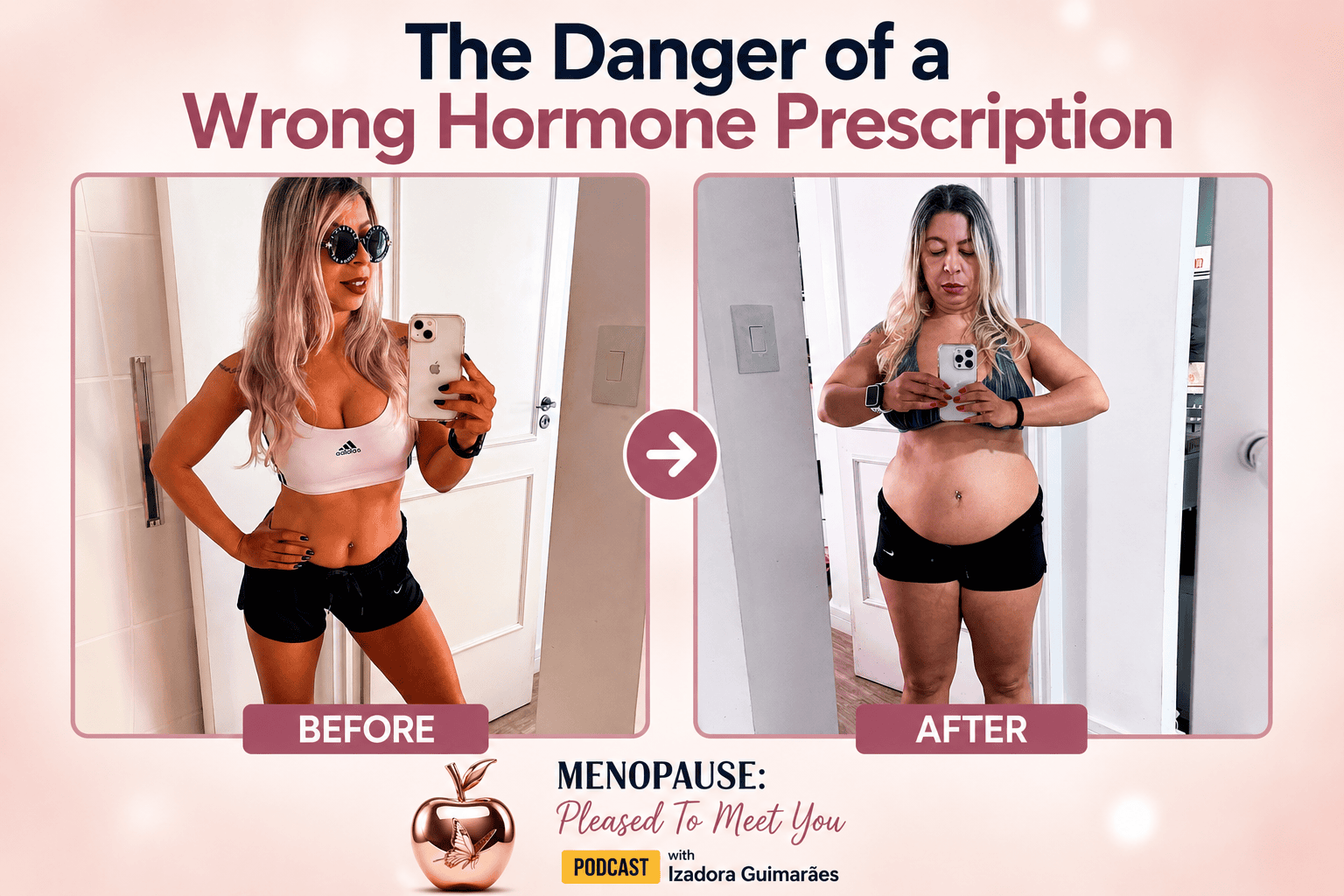
One photograph was taken on December 31, 2024.
At the time, I was trying to pose in a way that hid how much weight I had gained.
Approximately 30 days later, after returning home from the hospital, another photograph showed a dramatically different body.
Those images became part of the story I eventually decided to share.
Not because I believe photographs can explain a medical condition.
They can’t.
But because they show how dramatically my body changed and why I felt compelled to keep searching for answers.
I thought I was the only woman experiencing this
After everything happened, I decided to share my story online.
Until then, I believed I was the only woman experiencing something like this.
Then hundreds of women began contacting me.
They told me their stories.
Some described similar struggles with their bodies. Others told me about severe side effects or experiences with hormone prescriptions that had left them confused and searching for answers.
That was the moment I understood that my story was bigger than me.
Menopause misinformation is a global problem
The women who contacted me weren’t only from Brazil.
Women around the world were struggling with misinformation, lack of support and difficulty finding reliable answers about menopause.
That realization changed the direction of my work.
I decided to transform my social media and YouTube channel into a place where we could talk about menopause openly.
I created a podcast to bring doctors, specialists and real women into the conversation.
Because menopause isn’t a trend for me.
I don’t talk about menopause because it is popular.
I talk about it because I lived through it.
I’m not against HRT
There is one point I want to make especially clear.
I’m not against HRT.
I’m against misinformation.
I’m against women receiving hormone treatment without understanding what they are taking, why they are taking it and what the treatment is intended to address.
Hormone therapy is a personal medical decision that needs to be discussed with an appropriately qualified healthcare professional.
My story is not an argument against HRT.
It is an argument for better information, better communication and more careful menopause care.
Information gives women power
My message to women going through perimenopause or menopause is simple:
Learn.
Ask questions.
Understand your treatment.
Understand what HRT is.
Understand why a treatment has been recommended for you.
Then discuss your options with your healthcare professional.
The decision to use or not use hormone therapy should be made based on your individual situation and an informed medical conversation.
I wish I had known more in 2022.
Maybe my story would have been different.
But I also believe that experiences can create new paths.
Why I created Menopause: Pleased To Meet You
Today, this story is one of the reasons I’m building Menopause: Pleased To Meet You.
The podcast and this platform exist because menopause deserves a bigger conversation.
We talk about hormones and health.
But we also talk about relationships, culture, fashion, lifestyle and everything else that makes up the life of a woman over 40.
Because menopause isn’t the whole woman.
It is one part of her life.
And she deserves information that helps her navigate it.
The Multiverse of Women 40+
This is the Multiverse of Women 40+.
A place where women can find conversations, information and different perspectives about perimenopause and menopause.
My experience taught me that information matters.
Sometimes, it can change the decisions we make.
Sometimes, it can help us ask a better question.
And sometimes, simply knowing that another woman has been through something difficult can make you feel less alone.
My story is still unfolding
Even today, I don’t have every answer about what happened to my body.
I’m still searching.
I’m still learning.
And I’m still asking questions.
But I no longer believe that silence is the answer.
If sharing my story helps another woman ask her doctor a question she hadn’t thought to ask, or encourages someone to learn more before starting a treatment, then telling it is worthwhile.
This is my story.
And it is only one story in the much larger conversation about menopause.
Watch the full story
Watch Izadora Guimarães share her personal menopause journey, from discovering perimenopause to navigating hormone treatment, dramatic body changes, hysterectomy, years of searching for answers and the experience that ultimately led her to create a platform dedicated to women 40+.
WATCH THE FULL EPISODE ON YOUTUBE
Menopause: Pleased To Meet You brings together conversations about menopause, women’s health, hormones, longevity, relationships, culture, fashion and the many dimensions of life after 40.
More Play & Less Pause.
Latest News
- 13 de October de 2026
- 15 de September de 2026
- 9 de September de 2026
- 1 de September de 2026